 Skip to content



Guaranteed rent can be a strong option for landlords who want predictable monthly income and less day-to-day stress.
Instead of dealing directly with late rent, void periods and tenant issues, the landlord agrees a fixed monthly rent with a provider. The provider then manages the tenant side of the arrangement and pays the landlord the agreed amount, depending on the contract.
That sounds simple, and when the agreement is clear, it can work very well.
But not every guaranteed rent scheme is the same.
Some landlords get caught out because they focus only on the monthly figure and do not check the terms behind the offer. Others assume everything is included, only to find out later that repairs, compliance, void periods or exit terms work differently from what they expected.
So, what are the risks of guaranteed rent schemes?
In simple terms, the main risks are unclear contract terms, unrealistic rent offers, hidden exclusions, repair disputes, weak property management, provider reliability and confusion over who is responsible for compliance.
If you are new to the idea, you may want to read our simple guide on what guaranteed rent means for landlords first.
Is guaranteed rent risky?
Guaranteed rent is not automatically risky.
For many landlords, it can reduce risk because it makes rental income more predictable and removes some of the stress around tenants, arrears and void periods.
The risk usually comes from choosing the wrong provider or signing an agreement without understanding the details.
A reliable guaranteed rent provider should explain:
- what rent you will receive
- when you will be paid
- what happens during void periods
- who manages the tenant
- who deals with repairs
- what compliance support is included
- how the agreement can end
If those answers are vague, that is a warning sign.
Guaranteed rent should make your life simpler as a landlord, not create more uncertainty.
Risk 1: The rent offer may look better than the terms
Some landlords focus only on the monthly rent figure.
That is understandable. If one provider offers more money than another, the higher offer can feel like the obvious choice.
But the highest guaranteed rent offer is not always the safest one.
You need to look at what sits behind the number.
Before signing, ask:
- Is the rent really guaranteed every month?
- Are void periods covered?
- Are there any payment delays or grace periods?
- Can the provider reduce the rent later?
- Are repairs deducted before payment?
- Are there conditions that stop the guarantee applying?
A slightly lower offer from a reliable provider may be better than a higher offer with weak terms.
The goal is not just to get the biggest number on paper. It is to secure reliable income through a clear agreement.
If you are comparing guaranteed rent with a normal letting service, read our guide on guaranteed rent vs traditional lettings.
Risk 2: Void periods may not be covered in the way you expect
One of the biggest reasons landlords choose guaranteed rent is to avoid worrying about void periods.
But you should never assume every void period is covered automatically.
Some agreements may cover void periods fully. Others may include exclusions, grace periods or conditions.
Before signing, check:
- whether rent continues when the property is empty
- whether there is a rent-free period at the start
- whether the guarantee pauses during major works
- whether the property must meet certain standards
- whether void protection applies for the full agreement
This is one of the most important questions to ask.
If avoiding void periods is your main reason for choosing guaranteed rent, make sure the agreement explains this clearly in writing.
Risk 3: Repair responsibilities can become unclear
Maintenance is another area where landlords can get caught out.
Some landlords assume guaranteed rent means the provider pays for everything. That is not always the case.
In many agreements, the provider manages the repair process, but the landlord may still pay for certain works. This can include larger repairs, structural issues, appliance replacements or compliance-related improvements.
That is not necessarily a problem, but it needs to be clear before you sign.
Ask:
- Who handles repair reports?
- Who chooses the contractor?
- Do I approve quotes first?
- Is there a spending limit before landlord approval is needed?
- Are emergency repairs handled differently?
- Are contractor invoices marked up?
- What happens if repairs are needed before the property can be let?
A good provider should explain the maintenance process clearly.
You can also read our guide on property management fees in the UK to understand what landlords should expect from a managed service.
Risk 4: Compliance may still sit with the landlord
Guaranteed rent does not mean landlords can ignore compliance.
Even when a provider manages the property day to day, landlords still need to understand their responsibilities.
GOV.UK says landlords are responsible for keeping rented properties safe and free from health hazards, making sure gas and electrical equipment is safely installed and maintained, providing an Energy Performance Certificate, protecting deposits where required and checking right to rent in England. You can read the official guidance here: https://www.gov.uk/renting-out-a-property/landlord-responsibilities
GOV.UK also explains landlord safety duties around gas safety, electrical safety, smoke alarms and carbon monoxide alarms. You can read that guidance here: https://www.gov.uk/private-renting/your-landlords-safety-responsibilities
This matters because a guaranteed rent provider may help manage compliance, but the agreement should make the responsibilities clear.
Before signing, ask:
- Who arranges the gas safety certificate?
- Who arranges the EICR?
- Who checks the EPC?
- Who deals with smoke and carbon monoxide alarms?
- Who checks licensing requirements?
- Who keeps records?
- Who pays for certificates and remedial works?
If the answer is unclear, do not sign until it is explained in writing.
For landlords who want wider support, ABC Gone also helps with property management and landlord services across London and Essex.
Risk 5: You may have less day-to-day control
Guaranteed rent is designed to be more hands-off.
That is a benefit for many landlords, but it also means you may have less direct involvement in the day-to-day management.
For example, the provider may manage tenant communication, rent collection, inspections and minor maintenance decisions.
This can be ideal if you want less stress.
But if you prefer to approve every decision, choose every contractor and speak directly to tenants, traditional lettings or standard property management may suit you better.
Guaranteed rent works best when the landlord wants certainty and is comfortable with a professional provider managing the process.
Risk 6: The provider may not manage the property properly
The rent guarantee is only one part of the service.
The property still needs to be managed well.
Poor management can lead to unhappy tenants, delayed repairs, property damage, missed inspections and disputes at the end of the agreement.
Before choosing a provider, ask how they manage the property.
You should know:
- how often inspections happen
- how tenants report repairs
- how urgent repairs are handled
- how landlords receive updates
- how contractor work is checked
- how the property is returned at the end
A strong guaranteed rent service should protect both your income and your property.
If a provider only talks about the rent but says very little about management, that is a red flag.
Risk 7: The provider may not be financially reliable
A guaranteed rent agreement is only as strong as the provider behind it.
If the provider has poor systems, weak finances or unclear backing, the landlord could face problems later.
Before signing, look for signs of reliability.
Ask:
- How long has the company been operating?
- Do they have a physical office or local team?
- Do they manage properties in your area?
- Are they transparent about their terms?
- Do they have reviews or case studies?
- Is the rent guarantee backed in any way?
- Are they part of relevant schemes where required?
Landlords should be careful with any provider that overpromises, avoids questions or pressures them to sign quickly.
A reliable provider will not be afraid of due diligence.
If you are unhappy with your current agent, you may also find our guide on how to switch property managers useful.
Risk 8: You may not understand who is living in the property
Some guaranteed rent arrangements involve the provider renting the property and then placing tenants or occupiers.
This can work when managed properly, but landlords need clarity.
Ask:
- Who will live in the property?
- Can the provider sublet?
- Will the property become an HMO?
- Will licensing be needed?
- How will tenants or occupiers be checked?
- Who handles complaints or anti-social behaviour?
- Will the arrangement affect my insurance or mortgage?
Do not leave this vague.
If the agreement allows subletting or a company-let structure, make sure you understand how it works and what it means for your property.
Risk 9: Your mortgage or insurance may have conditions
Before signing any guaranteed rent agreement, landlords should check whether it affects their mortgage or insurance.
Some mortgage lenders and insurers may have rules about who occupies the property, whether the property can be sublet, whether company lets are allowed, or whether certain tenancy types are excluded.
This does not mean guaranteed rent is unsuitable.
It simply means landlords should check before agreeing.
If you are unsure, speak to your mortgage lender or insurer. It is better to confirm early than discover later that the agreement does not match your policy or lending conditions.
Risk 10: The agreement may limit your flexibility
Guaranteed rent agreements often run for a fixed period.
That can be useful because it gives both sides stability. But it can also limit your flexibility if your plans change.
Before signing, think about whether you may want to:
- sell the property
- move back into the property
- change agent
- renovate
- increase the rent
- end the agreement early
Check the notice period, break clauses and exit terms.
This is especially important if you may sell the property soon. You need to know whether viewings, vacant possession and notice periods could become an issue.
A good provider should not rush this conversation. They should explain what happens if your circumstances change.
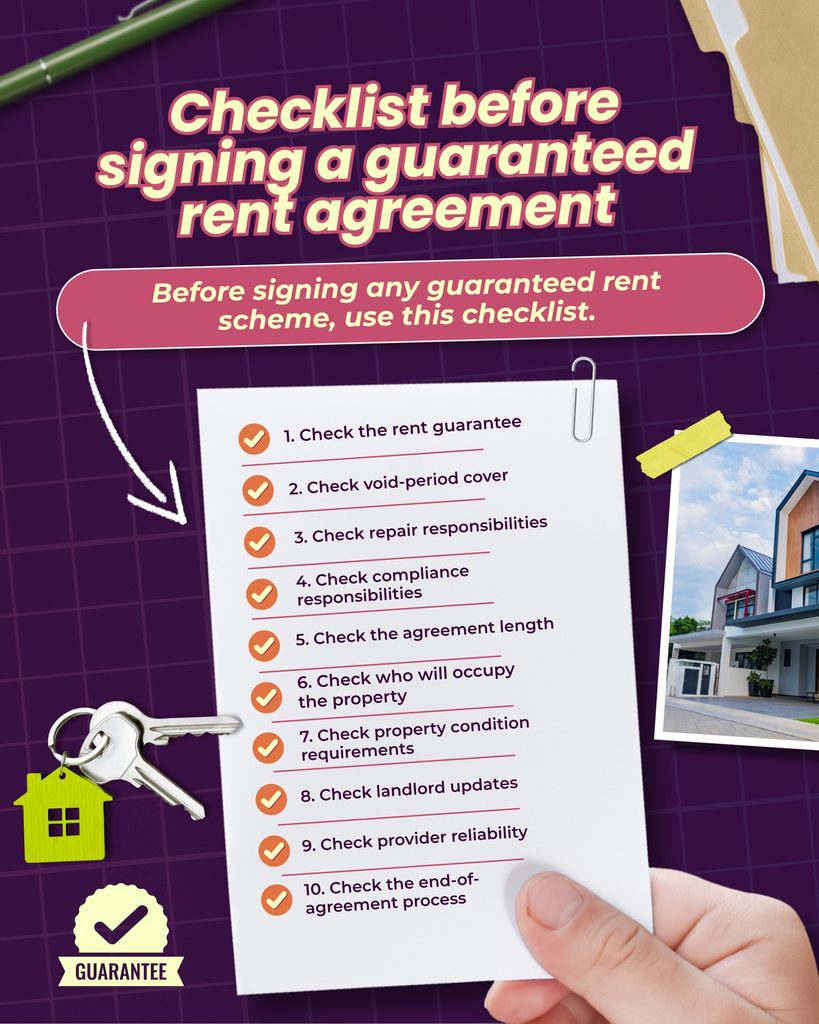
Checklist before signing a guaranteed rent agreement
Before signing any guaranteed rent scheme, use this checklist.
1. Check the rent guarantee
Confirm the exact monthly amount, payment date and what happens if the tenant does not pay.
2. Check void-period cover
Ask whether rent continues when the property is empty and whether any exclusions apply.
3. Check repair responsibilities
Find out who arranges repairs, who pays, whether you approve quotes and whether there are contractor mark-ups.
4. Check compliance responsibilities
Confirm who handles gas safety, EICR, EPC, licensing, smoke alarms, carbon monoxide alarms and record keeping.
5. Check the agreement length
Understand the term, notice period, renewal process, break clauses and exit fees.
6. Check who will occupy the property
Ask whether the provider can sublet, who the tenant or occupier will be, and whether the property use could affect licensing, insurance or mortgage terms.
7. Check property condition requirements
Ask whether any works are needed before the guarantee starts and who pays for them.
8. Check landlord updates
Confirm how often you will receive updates, inspection reports and maintenance information.
9. Check provider reliability
Look at reviews, local experience, office presence, terms, communication and whether the provider explains things clearly.
10. Check the end-of-agreement process
Ask how the property will be returned, how damage is handled and what happens if you want to sell or move back in.
Red flags to watch out for
Be careful if a provider:
- offers a very high rent without inspecting the property
- avoids explaining the agreement
- does not clearly answer repair questions
- cannot explain void-period cover
- pressures you to sign quickly
- does not discuss compliance
- will not confirm who occupies the property
- has vague payment terms
- refuses to put key promises in writing
A genuine guaranteed rent service should be transparent.
If something important is only said verbally, ask for it in writing.
Is guaranteed rent still worth it?
Yes, guaranteed rent can still be worth it.
For many landlords, the benefits are strong:
- predictable monthly income
- less rent chasing
- fewer void-period worries
- more hands-off management
- professional tenant support
The key is choosing the right provider and understanding the contract before signing.
Guaranteed rent should not be sold as magic. It is a property management and income arrangement that needs clear terms, strong systems and honest communication.
When done properly, it can make being a landlord much easier.
For a deeper comparison, you can also read guaranteed rent vs traditional lettings.
Why choose ABC Gone?
ABC Gone helps landlords across London and Essex with guaranteed rent, property management and lettings.
Our approach is built around clear communication, practical property management and more predictable rental income for landlords who want less stress.
We believe landlords should understand the agreement before signing.
That means explaining the rent, management process, repairs, compliance responsibilities and handover clearly.
If you are considering guaranteed rent, we can help you compare your options and decide whether it suits your property.
You can also visit our landlord services page here: https://abcgone.com/landlords/
Speak to ABC Gone before signing
Before agreeing to any guaranteed rent scheme, make sure you understand the risks, the terms and the provider behind the offer.
ABC Gone can help you review your options and explain what guaranteed rent could look like for your property.
If you want predictable rent without rushing into the wrong agreement, speak to our team first.
Book a guaranteed rent valuation with ABC Gone today and get clear advice before signing:
https://abcgone.com/book-your-valuation/
Helpful landlord guides
If you are comparing your options, these guides may help:
- What Is Guaranteed Rent? A Simple Guide for UK Landlords: https://abcgone.com/what-is-guaranteed-rent-2/
- Guaranteed Rent vs Traditional Lettings: Which Is Better?: https://abcgone.com/guaranteed-rent-vs-traditional-lettings/
- Property Management Fees in the UK: What Should Landlords Expect?: https://abcgone.com/property-management-fees-uk/
- How to Switch Property Managers Without Disrupting Tenants: https://abcgone.com/how-to-switch-property-managers/
- ABC Gone Guaranteed Rent: https://abcgone.com/guaranteed-rent/
- ABC Gone Landlord Services: https://abcgone.com/landlords/
- Our Services: Lettings, Guaranteed Rent & Fixed-Fee Sales: https://abcgone.com/our-services/
- Book a Valuation: https://abcgone.com/book-your-valuation/
FAQs
The main risks include unclear contract terms, repair disputes, void-period exclusions, poor property management, weak provider reliability and confusion over compliance responsibilities.
Guaranteed rent schemes can be safe when the provider is reliable and the agreement is clear. Landlords should always check the contract, payment terms, repair responsibilities and exit clauses before signing.
Yes, guaranteed rent can go wrong if the provider overpromises, manages the property poorly or fails to explain important terms. This is why landlords should do proper checks before agreeing.
Some guaranteed rent agreements cover void periods, but landlords should never assume this automatically. Always check the agreement and ask whether any exclusions apply.
It depends on the agreement. The provider may manage repairs, but the landlord may still pay for certain works. Ask for repair responsibilities, spending limits and contractor charges in writing.
Guaranteed rent may be better for landlords who want predictable income and less day-to-day stress. Traditional letting may suit landlords who want more control and are comfortable with voids and arrears risk.
Check the monthly rent, void cover, payment dates, repair responsibilities, compliance duties, agreement length, exit terms, who occupies the property and how the provider manages tenants.